When a Price Change Made Me Build My Own To-Do App
A personal story about how a Todo app price hike made me question my tool dependencies and build something simpler on my own terms.
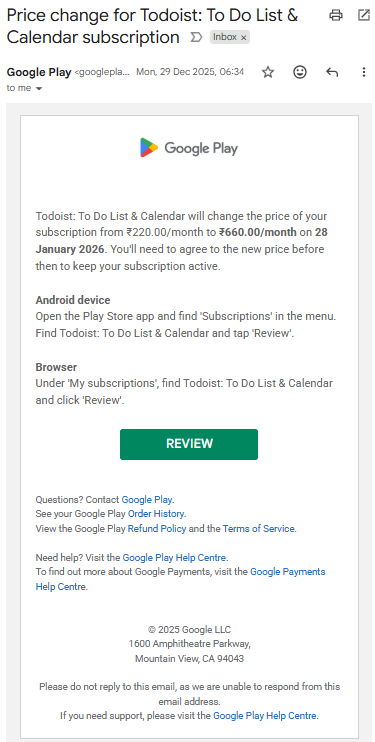
Try it live ↗In January 2026, my to-do app subscription jumped from ₹220/month to ₹660/month.
That was the moment I stopped thinking about features and started thinking about ownership.
At first, I didn’t think much of it. I had been using Todoist for a while, and it had become part of how I organized everything. It wasn’t just another app on my phone. It was something I had built an entire system around.
I started using Todoist in November 2023. Over time, it became more than just a place to jot down tasks. I created different projects for different areas of my life, like personal, professional, subscriptions, and learning. I used labels to organize tasks and filters to create different views. Eventually, this structure became my default way of thinking about work and life.
In January 2025, I upgraded to the Pro subscription. Not because I needed every feature, but for a few extras like more projects and better notifications. I also genuinely liked the system and wanted to support something I was actively using.
So when the price increase came, I didn’t react immediately. I had been on the Pro plan for just over a year, and the system was working well for me. But over the next few days, a simple question stayed with me:
Do I really need this?
What I Was Actually Using
When I looked closely at how I was using the app, the answer became clearer.
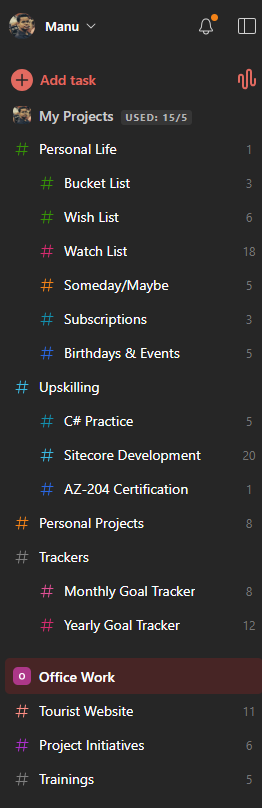
I wasn’t using most of the advanced features.
What I actually relied on was simple:
- Adding tasks
- Updating or rescheduling them
- Organizing them using projects and labels
- Viewing tasks in different ways using filters
- Syncing across devices, adding on mobile and completing on laptop
That was my workflow.
The product itself had evolved a lot. New features, AI capabilities, different ways to interact with tasks. And I could understand why.
But the things I needed were still quite simple. In some cases, I found myself wanting more control over how tasks were organized and handled, rather than more features.
For the way I worked, those additions weren’t essential.
It wasn’t really about the price either. It just made me stop and ask whether I needed everything I was paying for.
I realized I was using the simplest parts of a very powerful system.
The Real Question
At that point, I had an obvious option. I could switch to another app.
There are plenty of alternatives. I could have recreated the same system somewhere else and continued as usual.
But then another thought came up.
What happens when that changes too?
That’s when the problem shifted.
It was no longer just about pricing or features.
It was about dependency.
I wasn’t just using a tool. I had built a system I depended on, inside something I didn’t control. It could change over time, and I would have to keep adapting to it.
The Decision to Build
At that point, switching to another app would have solved the immediate problem.
But to me, it didn’t feel like a real solution. I would just be moving my system somewhere else and continuing the same pattern.
That’s when a different question came up.
Can I build something for myself?
Not a startup. Not a polished product. Just something that works for me.
Part curiosity, part challenge.
I wanted to see if I could take something I used every day and recreate a simpler version of it, on my own terms.
Jan 28–31: The First Version
I didn’t spend too much time planning.
Over one weekend, between Jan 28 and Jan 31, I built a basic MVP.
It was a simple .NET MVC application with just enough to create, store, and update tasks. Nothing more.
There was no real UI. No design. Nothing polished.
But it worked.
I could open it on my phone, add a task, and see it reflected instantly. That was the best part.
It wasn’t pretty, but it was built by me, and that changed how it felt to use it.
At that point, that was enough.
Then I Paused
In February, I ended up focusing on something else.
I got interested in how to work with AI as a developer, and naturally spent time exploring it.
I tried things like:
- AI-assisted coding
- Tools like Claude and Cursor
- Using AI for planning, writing, and testing code
- Integrating AI into the development workflow
The to-do app didn’t go anywhere. It was still there, just unfinished.
Coming Back in March
By March, a lot of those things started to make sense.
At some point, the question shifted from learning to applying.
Where can I use this in something real?
The to-do app was the obvious place to come back to.
This time, I wasn’t just building manually. I was using everything I had learned.
AI helped me:
- Move faster
- Structure things better
- Experiment more freely
The things I had skipped earlier, like a real frontend, better task organization, and a layout that worked on mobile, started coming together much faster than I expected. What would have taken days or even weeks earlier now took hours.
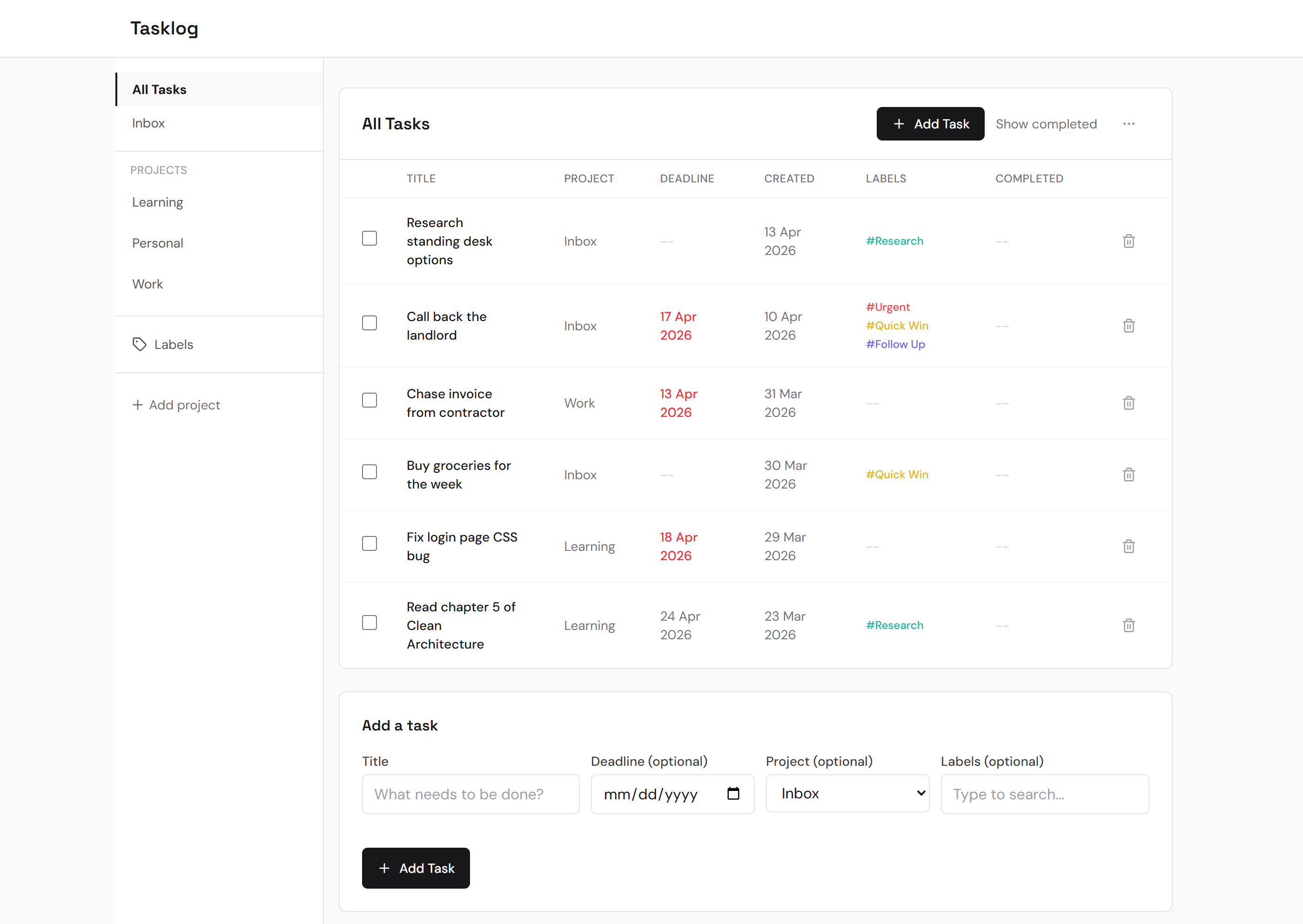
What had started as a rough experiment began to feel more usable.
Not perfect, but real progress.
What This Is (And What It Isn’t)
This isn’t about replacing Todoist.
I still think it’s a great product, and I understand the direction they’re taking.
This was more personal than that.
I didn’t need a more powerful tool. I needed something simpler, something that fits how I work and something I can change and shape without depending on external decisions.
Looking Back
Over time, the pricing has settled, and it’s still a reasonable product for what it offers today.
And to be honest, I still think it’s a great tool. The direction they’re taking, with AI, automation, and continuous improvements, makes sense. For many people, that added value is worth it.
But for me, that moment of change did something more important.
It made me pause and question what I actually needed from a tool, instead of just adapting to it.
And that shift is what pushed me to try building something of my own.
What Came Out of It
What started as a reaction to a price change turned into something more meaningful.
I learned how to build something end-to-end and how to use AI as a real development tool. But more than that, I started looking at my own workflow differently.
For a long time, I was just working inside a system. I had fit my habits, my projects, and the way I organized my work into something that was already defined. I never really questioned it. It was just how things were.
Building something for myself changed that.
I started thinking more about how I actually work, what I need, and what I don’t.
The result is simpler. It’s not perfect. But it does exactly what I need.
And more importantly, it’s mine.
Explore the Project
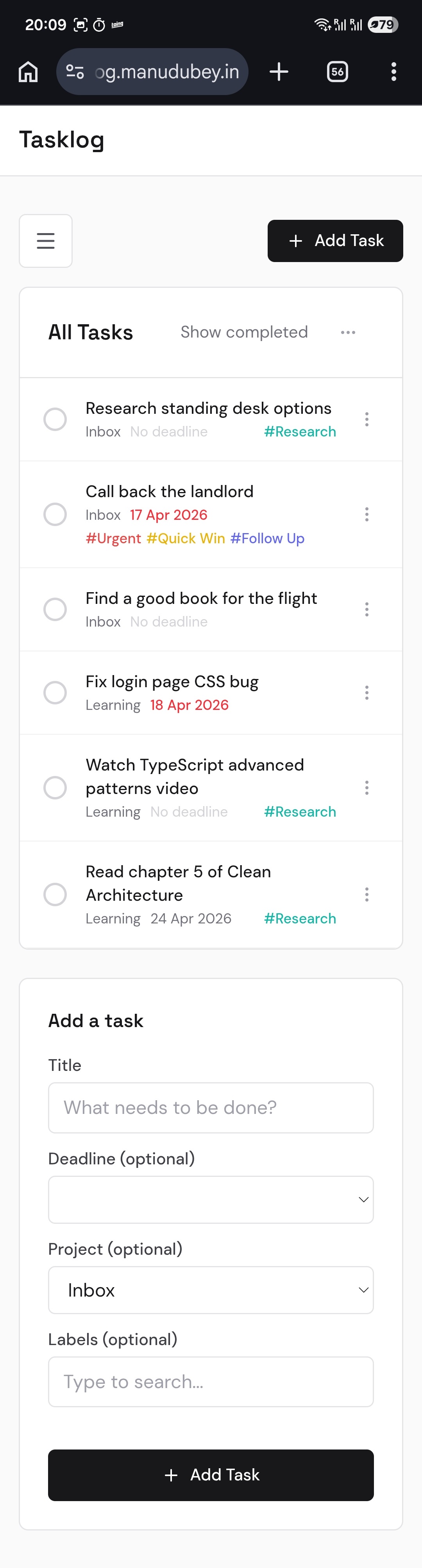
If you’re curious what that looks like in practice:
Try Tasklog live · View on GitHub
You might not need to build your own tool but it might make you rethink the ones you depend on.
By the way, this was just the “why” behind it. I will share the “how” in the next part.